
25/04/2026
The NIE Number Explained: Your First Step in Spanish Real Estate
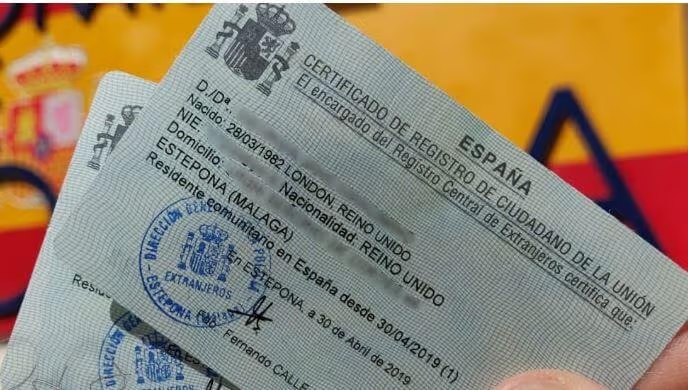
Before you can sign a contract, pay a deposit, or open a Spanish bank account, you need one document. Here is what it is, why it matters, and what you need to know before you apply.
If you are a foreign national buying property in Spain, the NIE number is the first thing you need. Not the second — the first. Before any property transaction can legally complete, before you can pay taxes on a purchase, before a notary can proceed with a deed, your NIE must exist. It is not a bureaucratic formality that can be sorted out later. It is a prerequisite.
And yet it is one of the most commonly underestimated steps in the Spanish buying process — particularly by international buyers who assume it is something that gets handled automatically, or that can wait until closer to completion. It cannot.
What the NIE Actually Is
NIE stands for Número de Identificación de Extranjero — Foreigner’s Identification Number. It is a unique tax identification number issued by Spain’s Ministry of the Interior to foreign nationals. It is not a residency permit. It does not grant you the right to live in Spain. It identifies you as a legal taxpayer within Spain’s system for the purposes of any financial, legal, or property-related transaction.
A unique personal tax identification number for foreign nationals in Spain
A residency permit, a visa, or proof of the right to live in Spain
Any foreign national completing a property transaction, paying Spanish taxes, or opening a Spanish bank account
Once issued, the NIE number itself does not expire — though the certificate confirming it may need updating
Why It’s Mandatory for Property Buyers
Every financial transaction linked to a Spanish property purchase triggers a tax obligation. The payment of transfer tax (ITP) or VAT (IVA), the registration of the deed at the Land Registry, the payment of local taxes — all of these require a tax identification number. Without a NIE, the Spanish tax system has no way to record you as the taxpayer, and the notary cannot proceed.
This applies regardless of your nationality, regardless of whether you are buying outright or with a mortgage, and regardless of the purchase price. There are no exceptions.
Timing matters
The NIE application process takes time — sometimes several weeks depending on how and where you apply. Starting this process only when a purchase is already in progress is one of the most common causes of delay in Spanish property transactions. Begin the process as early as possible, ideally before you start seriously viewing properties.
Where and How to Apply
There are two main routes for obtaining a NIE as a foreign national:
In Spain
Applications can be made at a Foreigners’ Office (Oficina de Extranjeros) or a designated National Police station (Comisaría de Policía). In high-demand areas — Málaga, Marbella, Alicante, Madrid, Barcelona — appointments can be limited and waiting times significant. Booking early is essential.
Through a Spanish Consulate Abroad
If you are not yet in Spain, you can apply for a NIE through the Spanish consulate in your home country. This is often the most practical route for buyers in early stages of their search. Processing times and documentation requirements vary by consulate.

Via a Appointed Representative (Poder Notarial)
It is also possible to authorise a representative — such as a Spanish lawyer or gestor — to apply for the NIE on your behalf through a power of attorney (poder notarial). This is a common approach for buyers who cannot travel to Spain or to a consulate before their purchase timeline requires the number.
The application process involves documentation requirements that vary by situation, and your agent’s guidance here is essential. The paperwork required, the forms used, and the supporting evidence needed can differ based on your nationality, your country of residence, and the specific office processing your application.
What the NIE Enables
Once you have your NIE, a number of essential steps in the Spanish property purchase become possible:
Opening a Spanish bank account — required for paying purchase taxes and setting up utilities. Signing the contrato de arras (preliminary purchase contract). Completing the escritura de compraventa before a notary. Registering ownership at the Registro de la Propiedad. Filing any required Spanish tax declarations related to the purchase.
In short, the NIE is what connects you, as a foreign buyer, to Spain’s legal and financial infrastructure. Without it, none of the above is possible.
“International buyers often focus on finding the right property. The professionals who serve them best are those who ensure the legal groundwork — starting with the NIE — is in place before the search even begins.”
One More Thing: the NIE Certificate vs the Number
A common source of confusion is the difference between the NIE number itself (permanent, does not change) and the NIE certificate that was issued when you obtained it. The certificate has a validity period and may need to be renewed if it has expired — even though the underlying number remains the same. For the purposes of a notarial transaction, a current, valid certificate is required. This is another area where professional guidance avoids last-minute complications.